




07 Oct 2026
Connected Vehicles Explained: Skills Required to Work in Telematics & IoT
More Links




For a country to climb up the economic ladder, and get out of the pit of unemployment, it needs the uninterrupted support of a highly skilled workforce. A workforce low in skills can perpetuate inequality, as well as, have negative impact on a country’s growth graph, as it becomes tough for the private sector to sustain and thrive without skilled labors. Speaking of which, according to a recent study by the World Bank, about one third of the working age population in low and middle income countries lack the basic skills required to get quality jobs.
Skill development, for one, can be considered as the master plan to tackle unemployment, raise incomes, and improve standards of living. People lose their chances at self-improvement due to lack of proper education and training, which often results in losing dependable employment opportunities. The same things later acts as a catalyst in restricting them from achieving their full productive potential, and making an influential contribution to the country’s economic growth. In the present world, contrary to what most of us might believe, skill development is no longer a matter of choice. It has now become imperative for every individual to get skills training in order to adapt, survive and succeed in the increasingly competitive job market. Through skill development, one can, not just become future ready by improving their proficiency in a job, this process is also helpful in determining one’s ability to execute their plans with higher rate of success in a given time.
Need for Skill development in India
While skills and knowledge are the backbone of a country’s growth and social development, India has a literacy rate of only around 77%, which is considerably low even against some of the least developed countries in the world. However, as a matter of fact, literacy is not just limited to education. It is an umbrella concept, comprising everything that has to do with skills, including technical expertise, transferrable skills, vocational skills, digital skills, and other such knowledge and abilities required for employment and livelihood. That explains why, when it comes to employability of Indian graduates, only about 47% of them manage to pass the mark. By the year 2022, the Indian workforce is expected to have a growth of about 27%. However, what is more concerning now is, only around one-fourth of the current workforce has ever gone through skill development programs. All these data pretty much shows how much India is need of a skilled workforce, and better awareness on the same.
Indian industries are currently experiencing a paradigm shift like never before, owing to many dynamic factors like globalization, ever-changing market, and industry 4.0 being at play. In this time and age, there would barely be any organization that is not in a continuous quest for skilled workers, ones that have clear signs of growth, as well as have the potential to become assets for the organization, with their outstanding performances. Skills increase productivity, and ensure better quality work, resulting in significant outcome. Which is why, the World Trade Organization went ahead and forecast about an estimated 3%-5% increase in the GDP of India by the year 2035, considering the country focuses on skill development and training. Basically, the overall development of this country largely depends on efficient training and skilling of the youth in a timely manner.
Government Initiatives for Skill Development in India
The Skill India Mission under the Ministry of Skill Development and Entrepreneurship (MSDE), launched by the Honorable Prime Minister of India, Narendra Modi, aims to train over 40 crore Indian youth in different skills by 2022. By setting up the MSDE, and an enabling framework to complement the same, the government has, once and for all, made public its top priorities, including job creation, entrepreneurship, and attracting private investments. Next up, there are also adequate strategies followed by the government in order to attract foreign direct investment, as well as to increase manufacturing growth. Also, through MSDE’s flagship scheme called Pradhan Mantri Kaushal Vikas Yojana (Skill India Mission), young Indians are given an opportunity to get their hands on industry-relevant skills training, and increase their chance at employability. The prevalence of the wide range of skilling programs such as, National Apprenticeship Training Scheme, Deen Dayal Upadhyaya Grameen Kaushal Yojana, National Urban Livelihoods Mission, and the National Rural Livelihoods Mission, are clear evidence to prove the government’s untiring commitment towards producing competent youth to join the labor market.
In addition to that, an array of flagship schemes, including Make in India, Digital India, Start-up India, and Stand-up India have been introduced by the government, in an attempt to fuel the rise of more exceptionally productive and highly skilled MSMEs that would further help in generating labor demand, as well as, employment opportunities. The Atal Innovation Mission is another platform that aims at encouraging and promoting a culture of innovation and entrepreneurship among the new generation of youth, and also to share innovative ideas through the same.
Conclusion
To summarize it all, in today’s fast transforming world, where every industry is getting a digital makeover, it is impossible to imagine an unskilled workforce to add value. If anyone wants to fit into the increasingly demanding job roles, one has to possess the required skill sets, which can only be acquired through various skill development programs. Skill development is a tool to empower yourself, and prepare for the future job market. It helps in getting you equipped with the most sought after skills in the market to compete for better employment opportunities and safeguard your future.

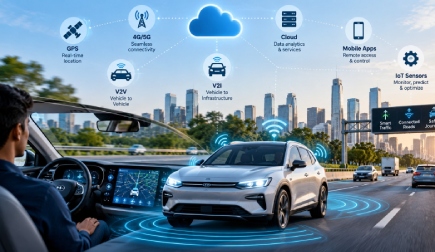
Connected Vehicles Explained: Skills Required to Work in Telematics & IoT
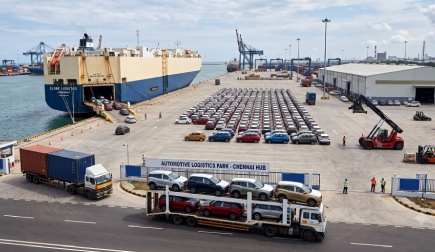
Automotive Logistics & Supply Chain: Skills Driving the Next Phase of Mobility
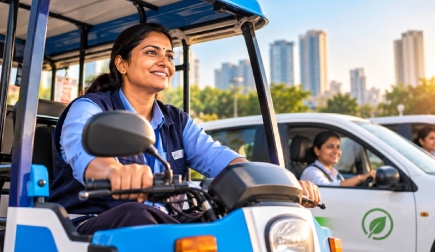
Growing Force of Women in E-Rickshaw and Fleet Services
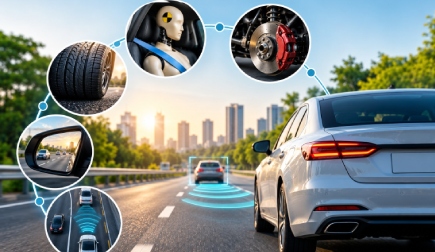
Road Safety Starts with Science: What Every Indian Driver Should Know
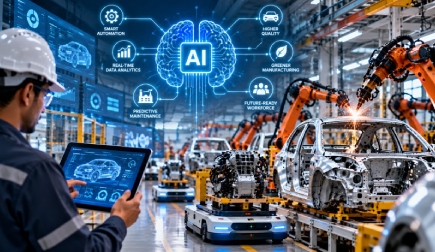
AI in Automotive: How Smart Factories Are Changing Production Lines
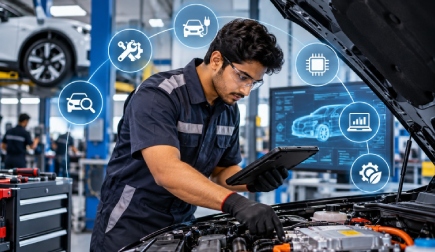
Skills Needed for Modern Auto Service Technicians
The modern automobile is no longer just a machine that takes people from one place to another. It is increasingly becoming a connected...
A car may be assembled in one factory, but its journey begins much earlier. Thousands of components can come from different suppliers, cities and countries before they reach the production line.
India's mobility sector is witnessing a quiet but powerful transformation. Women are increasingly taking the driver's seat in e-rickshaws...
Every journey on India's roads involves thousands of decisions made in a matter of seconds
The automotive manufacturing floor is undergoing a fundamental shift. For decades, production efficiency...
The role of an auto service technician in India is changing rapidly. A technician who once spent most of the day working on engines...
