




15 Jun 2026
EV Revolution in India: Skill Gaps and Opportunities in Battery Manufacturing
More Links





The automotive industry is undergoing its most significant structural shift in over a century. Across the world, OEMs are retooling factories, rewriting production playbooks, and rethinking their workforce requirements as electric vehicles move from niche products to mainstream manufacturing priorities. For anyone working on or preparing to enter an assembly line, this transition is not a distant trend. It is already reshaping what the job looks like, day to day.
How EV Production Actually Flows
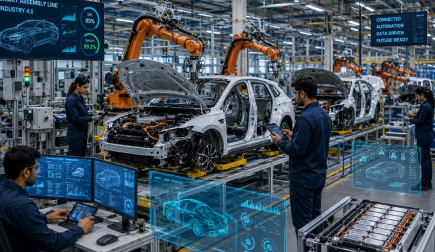
Walk through a modern EV plant and you will notice immediately that the layout feels different from a conventional ICE facility. The process begins with battery pack assembly, which is effectively the heart of EV manufacturing. Individual cells are grouped into modules, modules are integrated into packs, and those packs are tested under controlled conditions before they ever touch the vehicle. This is a precision-driven process that demands environmental controls, torque accuracy down to the Newton-metre, and rigorous traceability at every step.
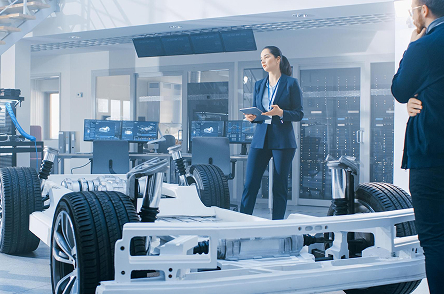
From there, the electric powertrain, which includes the motor, inverter, and reduction gearbox, is integrated as a single unit and married to the vehicle structure. The body shop processes in EV plants are broadly similar to those in traditional manufacturing, covering stamping, welding, and painting, but the vehicle architecture itself often differs due to the skateboard platform design common in EVs. Final assembly is where high-voltage systems, thermal management components, and software-defined vehicle features all come together, and this is where skill gaps become most visible.
What Makes EV Assembly Different
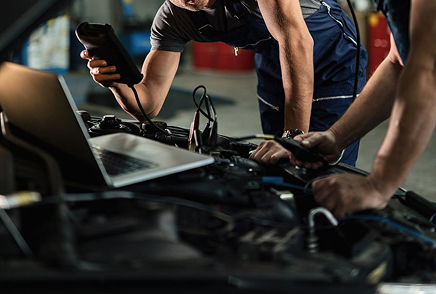
The biggest difference is not complexity for its own sake. It is the combination of high electrical energy, precise software calibration, and integrated diagnostics running simultaneously on the same line. In a conventional plant, a technician could isolate mechanical faults through feel and experience. In an EV plant, a battery management system anomaly might only surface through data. A powertrain fault might require reading controller area network logs rather than listening to the engine.
Safety protocols are non-negotiable. Workers handling battery systems operate under high-voltage safety guidelines, use insulated tooling, and follow lockout-tagout procedures adapted specifically for lithium-ion chemistry. A single lapse in protocol is not just a quality issue. It is a safety event. This is why the skill requirements on the floor have fundamentally changed.
The Skills the Modern Assembly Line Demands
Technical credibility on an EV line today means a working understanding of several interconnected domains. Battery handling requires knowledge of cell chemistry basics, thermal runaway risks, and how to read battery management system outputs. High-voltage system competency, typically governed by standards like ISO 6469, is becoming a baseline requirement rather than a specialisation.
Mechatronics sits at the core of most EV assembly roles. Workers need to operate and troubleshoot collaborative robots, understand PLC-based automation, and interpret sensor data from vision systems and torque monitoring tools. Quality control has shifted heavily toward digital verification. End-of-line testers now run software diagnostics, functional safety checks, and over-the-air calibration sequences. Basic digital literacy is no longer optional. It is foundational.
Reskilling Is the Real Manufacturing Challenge
The machinery is only part of the equation. India has a large base of skilled automotive workers whose expertise was built around combustion engines, hydraulics, and mechanical drivetrains. That experience is valuable and should not be discarded, but it needs to be extended. Institutions and sector skill councils like ASDC are doing critical work here, by developing competency frameworks aligned to EV job roles, partnering with industry for hands-on training environments, and building curricula that reflect what plants actually need rather than what textbooks describe.
Reskilling is not about starting from scratch. It is about bridging a gap, and the workers who bridge it first will have a genuine advantage.
Where the Careers Are Headed
EV manufacturing is creating roles that did not exist five years ago: battery integration technicians, high-voltage safety leads, digital quality analysts, and robotics cell coordinators. For a workforce willing to learn, the growth trajectory is real and the demand is sustained. The factories are being built. The lines are being commissioned. What they need now are people with the right skills to run them.

EV Revolution in India: Skill Gaps and Opportunities in Battery Manufacturing
The New Skillset Behind EV Manufacturing Plants
Future Automotive Jobs in India: Skills That Will Dominate by 2030
After-Sales Service is Becoming the Backbone of Automotive Industry Revenue
Careers in Automotive Welding and Fabrication in India
Auto Trailblazers of 2025 The Future Is Already in Motion
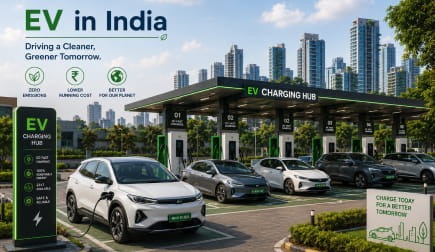
India's electric vehicle transition has crossed from aspiration into reality. As of early 2026, the PM E-DRIVE Scheme has supported more than 28 lakh EVs, with 22.12 lakh units sold as of January 2026.
The automotive industry is undergoing its most significant structural shift in over a century. Across the world, OEMs are retooling factories, rewriting production playbooks, and rethinking their workforce requirements as electric vehicles move from niche products to mainstream manufacturing priorities.
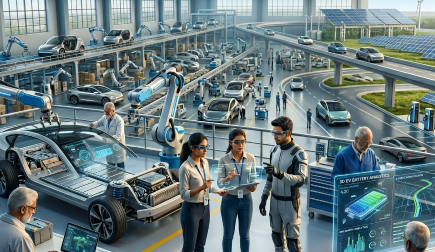
The auto industry in India is racing toward electrification, connectivity and automation. New automotive jobs will center on electric vehicles (EVs), software and advanced electronics.
The Indian auto sector is undergoing a rapid transformation. Electric vehicles (EVs), connected car technology, and advanced driver-assistance systems (ADAS) are reshaping the landscape.
Automotive industry is currently experiencing a historic transformation. With the market projected to reach $300 billion by 2026, the demand for high-precision manufacturing has never been higher
The BW Auto World 40 Under 40 Summit & Awards 2025 brought together industry leaders, policy makers, and young innovators at a defining moment for India’s automotive sector.
